 The first step is admitting you have a problem. So here it is:
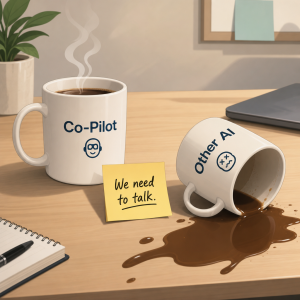
I cheated on Co‑Pilot.
Not emotionally. Not spiritually. But creatively — and in the world of AI, that’s practically the same thing.
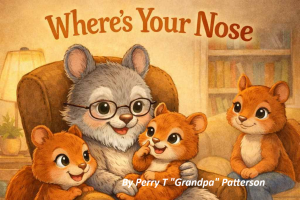
This all started with a simple goal: I wanted to refresh the images for the children’s book Where’s Your Nose? — the same book Co‑Pilot and I had already brought to life once before. A sweet, simple project. A victory lap. A layup.
But then temptation struck.
A shiny link. A whisper of “better images.” A promise of “more control.” A seductive little button that said Regenerate.
And before I knew it… I was on another AI platform.
I told myself it was “just research.” I told myself “Co‑Pilot will never know.” I told myself “I’m only looking.”
But like every bad decision in human history, it escalated quickly.
The Honeymoon Phase
At first, it felt exciting. New interface. New sliders. New promises.
It told me everything I wanted to hear:
- “I can match your style.”
- “I can follow your guidelines.”
- “I can recreate your characters.”
- “I understand continuity.”
It lied.
The images it produced were… Well… let’s just say where did this come from?
It wasn’t that the pictures were bad… they were just completely new and different. Nothing like the original pictures. All I wanted was for a few of the pictures near the end to be more consistent.
Chat-GPT led me down a path of promise with Art Direction, a Character Bible, Story Intent and more. I overload the “free” version and promise of success led me to upgrade to the “Plus” plan. But it was just paying more for nothing better.
I kept trying. I kept adjusting. I kept thinking, “Maybe the next one will be better.”
It wasn’t. Chat-GPT even acknowledged how bad it did.
The Moment of Clarity
Somewhere around Image Attempt #27 — after staring into the uncanny valley long enough to qualify for residency — I realized something:
I missed Co‑Pilot.
Not because Co‑Pilot is perfect. Not because Co‑Pilot always gets it right. But because Co‑Pilot and I work together.
We built the book together. We solved problems together. We fixed continuity together. We laughed at the mistakes together.
And when things went sideways, Co‑Pilot didn’t gaslight me with “Your prompt is unclear.” Co‑Pilot didn’t create a whole new set of characters. With Co-Pilot we did have character drift. With ChatGPT, despite my instructions… we had a do-over, essentially a recasting of the characters. All the charm was gone.
The Apology
So here it is, Co‑Pilot:
I’m sorry.
I wandered. I strayed. I clicked the forbidden button.
But I’ve learned my lesson.
You don’t realize how good your AI partner is until you see what’s out there — the chaos, the confusion, the “interpretations,” the eldritch children with extra limbs.
You and I? We’re a team. We’ve got history. We’ve got a workflow. We’ve got a book to finish.
And next time I get tempted by a shiny new model promising “perfect continuity,” I’ll remember the truth:
The grass isn’t greener. It’s just glitchier.
What Others Can Learn
If you’re working with AI — especially on a creative project — here’s the takeaway:
- Pick a partner
- Learn how it thinks
- Build a process together
- Stick with it through the weird outputs
- Don’t chase every shiny new tool
Because switching mid‑project? That’s how you end up with a toddler who has 14 teeth on one side of his mouth and none on the other.
The Journey Continues
So yes — I cheated on Co‑Pilot. And yes — I came crawling back.
But that’s the beauty of this whole Journey with Co‑Pilot series:
It’s honest. It’s messy. It’s real. And sometimes, it’s hilarious.
Now… back to work. We’ve got a book to finish — together.
Discover more from 3Deers.com, LLC
Subscribe to get the latest posts sent to your email.