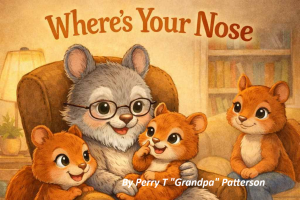
Where’s Your Nose – on Amazon Kindle
I never planned to write a book — certainly not a children’s book. Where’s Your Nose started as a poem I wrote on a whim after playing a silly game with the Grandbosses while my daughter watched. Later that night, the feeling lingered: the joy of the moment, the awareness that the kids won’t remember it, and the quiet look on my daughter’s face that said, “I’ve seen this before.”
I sat down and wrote the story in one shot. No outline, no plan, no AI. Just me, the memory, and the words. Then life moved on, and that little poem sat untouched for almost a year.
⭐ Rediscovering the Story
Fast‑forward to semi‑retirement. I finally had time to tinker, explore, and play with new tools. I’d been experimenting with AI—especially Copilot—on all kinds of things. One day I stumbled across that old poem and thought:
“What if I turned this into a real children’s book?”
Not to chase a dream of being an author. Just because it felt like a fun, meaningful project to do with this new AI “partner” I’d been getting to know.
⭐ Protecting the story, using AI for the pictures
Here’s the key part: I never asked Copilot to rewrite the story. In fact, when it started to drift away from my voice, I stopped it. The words were mine, and I wanted them to stay that way.
Where Copilot did shine was in helping me imagine and draft the pictures. I gave it cues—Grandpa, grandkids, cozy scenes, the feel of the game—and it generated images that matched the tone I was going for. It helped me think in pages, not just lines. It nudged me toward a visual rhythm: which moments deserved a full spread, which ones were quieter, which expressions mattered.
The story stayed human. The visuals got a boost from AI.
⭐ When continuity broke and ChatGPT stepped in
As the image set grew, a problem appeared: continuity. The characters started drifting. Grandpa didn’t always look like the same Grandpa. The kids shifted slightly from page to page. The “model” we’d accidentally created at the start wasn’t being followed consistently.
That’s when I brought in ChatGPT—not to change the story, but to help diagnose and correct the visual drift. I used it to:
- clarify prompts so the characters stayed consistent
- refine how I described scenes
- think through layout and page flow
- get back to the original look and feel we’d established
In other words, Copilot helped me generate the pictures, and ChatGPT helped me regain continuity when things wandered off model.
⭐ From files to a real Kindle book
Once the story and images felt right, the project shifted from creative to technical. I assembled the pages, created the interior file, and used Kindle Create to turn everything into a KPF. Copilot was useful here too—walking me through:
- fixed‑layout setup
- exporting the KPF
- navigating KDP’s upload screens
- choosing pricing, DRM, and keywords
- writing a clean, parent‑friendly book description
Then came the moment that made it real: I hit Publish on the Kindle version. A poem written on a whim, inspired by a game with the Grandbosses, was now a live children’s book on Amazon.
⭐ The moment that mattered most
As satisfying as it was to see the Amazon page, the moment that hit me hardest was quieter. My daughter read the story and, almost offhand, said something that stayed with me. No way would she remember, but watching she remembered me playing with #1… and it really hit home. She would never remember it, but she could certainly feel it.
That’s when I realized this book isn’t just for the grandkids. It’s a bridge between generations—a little loop of memory connecting my daughter, her kids, and me.
⭐ What this journey really says about AI
This whole experience didn’t convince me that AI can write for us. It convinced me that AI can work with us—if we stay in charge.
- The story was mine. I defended it.
- Copilot helped me explore visuals and handle the technical steps.
- ChatGPT helped restore continuity when the images drifted.
AI didn’t create the heart of this book. It helped me carry it across the finish line.
And that, to me, is the real story: a grandparent, a whim, a poem, some curious experiments with AI—and a children’s book that now lives on Kindle.
Discover more from 3Deers.com, LLC
Subscribe to get the latest posts sent to your email.