
For years, scientists have debated climate change.
Politicians have argued.
Experts have written reports.
Television personalities have pointed fingers.
And through it all, one question remained unanswered:
What is really causing Global Warming?
It turns out the answer was hiding in plain sight.
Microsoft.
The evidence began appearing on an otherwise ordinary week.
First, Microsoft suffered a major outage. Outlook stopped cooperating. Copilot became confused. Businesses across the globe found themselves staring at loading circles and timeout messages. My own client’s applications started throwing ODBC connection errors while attempting to save data into Azure. Work slowed. Productivity stopped. Coffee consumption increased dramatically.
At first, nobody connected the dots.
Then something remarkable happened.
Florida got cold.
Not “wear a light jacket” cold.
Not “close the windows tonight” cold.
I mean real Florida cold.
The kind of cold that causes residents to search closets for clothing they haven’t seen since moving south. The kind of cold that sparks community-wide discussions about whether long pants are really necessary.
Temperatures dipped below sixty degrees.
Below sixty!
Coincidence?
I think not.
 As Microsoft systems remained offline, temperatures continued falling. The evidence was now overwhelming. Massive data centers, normally generating untold amounts of digital warmth, were suddenly disrupted. The world cooled almost immediately.
Then the FAA experienced communication issues.
Air traffic was grounded.
More signs of atmospheric instability.
Experts searched for complicated explanations involving telecommunications routers, network capacity upgrades, server health checks, and infrastructure dependencies.
Meanwhile, I continued following the data.
The pattern was clear.
Microsoft down.
Florida cold.
Case closed.
Naturally, the scientific establishment may attempt to challenge my findings. They may request peer review, statistical analysis, mathematical models, or something they call “evidence.”
However, I would remind them that I possess something even more powerful than evidence.
I have observations.
 The sequence of events is undeniable:
- Microsoft systems went down.
- Florida temperatures dropped.
- Residents considered wearing socks.
- Microsoft restored service.
- Florida returned to regularly scheduled summer programming.
Ladies and gentlemen, the conclusion practically writes itself.
Therefore, I am announcing a revolutionary climate strategy.
The next time temperatures exceed ninety-five degrees in South Florida, simply schedule a maintenance window for Microsoft 365.
Problem solved.
You’re welcome.
Disclaimer: This article is intended for entertainment purposes only. Neither Microsoft, Azure, Outlook, FileMaker, ODBC, the FAA, climate scientists, weather forecasters, or confused Florida residents have endorsed this research. Any resemblance to actual science is purely coincidental. Results may vary depending on humidity.
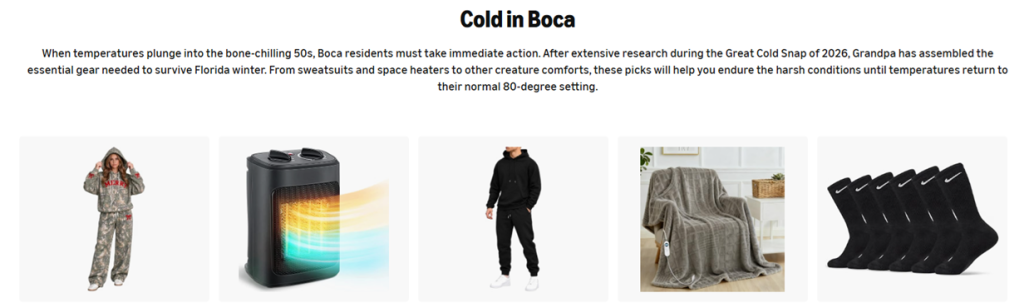
Grandpa Picks Boca:
Discover more from 3Deers.com, LLC
Subscribe to get the latest posts sent to your email.